
IB Math Command Terms Explained
Understanding command terms is one of the most important skills for success in IB Mathematics. Many students lose marks not because they do not understand the topic, but because they misunderstand what the question is asking them to do.
In IB Math AA and AI exams, every question contains command terms that tell you exactly how to respond, what the exercise expected you to do. These words indicate the depth of explanation required and the type of reasoning expected by examiners.
Learning how to interpret these command terms correctly can significantly improve your exam performance and help you maximize marks even on questions you find challenging.
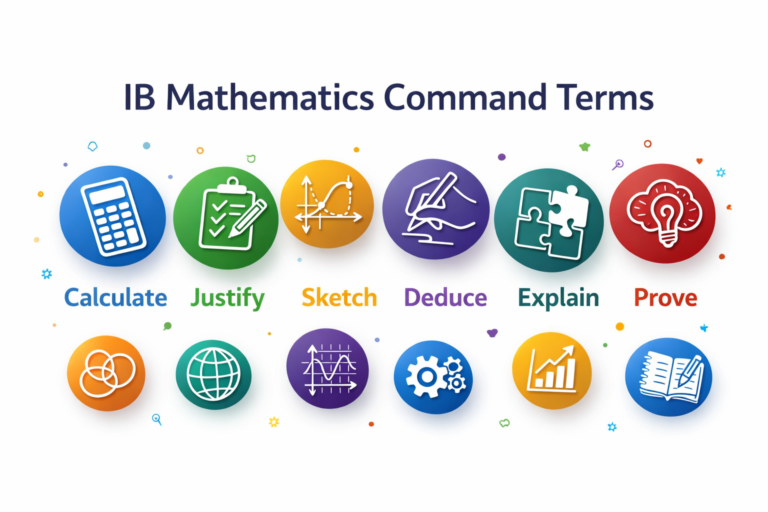
Why Command Terms Matter in IB Math?
IB exam questions are designed to test more than calculation skills. They evaluate your ability to explain reasoning, interpret results, and communicate mathematical thinking clearly.
For example, two questions might look similar but require very different responses:
One might ask you to calculate a value.
Another might ask you to justify your answer.
Another might ask you to comment on the result.
Students who ignore these distinctions often lose marks even when their calculations are correct.
Understanding command terms allows you to approach each question strategically and respond exactly as the markscheme expects
Most of the students I teach begin with weak confidence in topics like integration, trigonometric identities, or complex functions. After a few lessons, they gain clarity, start solving questions independently, and feel more prepared for mock exams and final assessments. Whether you’re aiming for a 5 or pushing for a 6 or 7, personalized IB tutoring helps you understand the reasoning behind each step rather than memorizing formulas.
Common IB Math Command Terms
Show That
When a question asks you to show that a result is true, the answer is already provided in the question. Your task is to demonstrate how that result is obtained.
This usually means:
starting from the given information
performing the required algebraic or analytical steps
arriving at the specified expression or value
Even if the final result is given, you must clearly show the intermediate steps to receive full marks.
Hence
The command term hence means you should use the result from the previous part of the question.
Often, the previous answer provides a shortcut that simplifies the next step.
Students sometimes ignore the earlier result and solve the problem from scratch. This is usually more complicated and can lead to mistakes.
When you see “hence,” always look at the previous answer and think about how it helps.
Justify
When asked to justify, you must provide mathematical reasoning that proves why your answer is correct.
This could involve:
explaining why a method is valid
showing algebraic reasoning
referencing properties or definitions
A simple answer without explanation will usually not receive full marks.
Comment
The command term comment asks you to interpret or explain the significance of a result.
This often appears in modeling or statistics questions where you must connect mathematical results to a real-world context.
A good comment typically includes:
what the result means
whether it is reasonable
how it relates to the situation described in the question
Sketch
When a question asks you to sketch a graph, you are not expected to produce a perfectly accurate drawing. Instead, you should show the main features of the graph clearly so that its behaviour can be understood.
A good sketch should include the most important characteristics of the function.
- X and Y Intercepts
- General shape of the graph
- Asymptotes
- Turning points (max and min)
These elements allow the examiner to understand the important features of the function.
Given / Given that
In probability questions, “given” means that some information is already known and must be taken into account when calculating the probability.
Mathematically, it means conditional probability.
It is written as:
P(A∣B)
This means:
The probability that event A happens given that event B has already happened.
In other words, we restrict the sample space to outcomes where B is true.
Write down
When a question asks you to write down a value, you are expected to state the answer directly without performing calculations.
The answer is usually already visible from a graph, table, diagram, or from a result given earlier in the question.
This command term tests whether you can recognize information quickly, rather than compute it.
TIP: When you see “write down”, do not waste time doing calculations. The answer should be immediate and clearly visible from the information given.
This type of question usually awards one mark, so a short and direct answer is expected.
Find
When a question asks you to state something, you should give the answer clearly and directly without showing calculations or detailed explanations. The response is usually a fact, definition, value, or rule that can be identified immediately from the information provided or from known mathematical results.
This command term typically expects a short and precise answer, rather than a full solution or justification.
The command term “find” normally expects the complete working leading to the final answer, not just the result itself. Your steps should be clear so the examiner can follow your reasoning and award method marks even if the final value is incorrect.
State
When asked to justify, you must provide mathematical reasoning that proves why your answer is correct.
This could involve:
explaining why a method is valid
showing algebraic reasoning
referencing properties or definitions
A simple answer without explanation will usually not receive full marks.
Describe
When a question asks you to describe something, you should give a clear explanation of the relevant features or characteristics. This usually involves explaining what is happening or how something behaves, often using information from a graph, table, or mathematical result.
The answer should be written in words and highlight the key patterns, trends, or properties that can be observed. Calculations are usually not required, but the description should be precise and based on the information given.
Determine
When a question asks you to determine something, you must find the value or result using appropriate mathematical reasoning. This usually involves performing calculations, solving equations, or using information provided in the question such as graphs, formulas, or previous results.
Your answer should show the necessary steps and reasoning leading to the final result.
Verify
When a question asks you to verify a result, you must show that a given statement or value is correct by using mathematical calculations or reasoning. This usually involves substituting values, simplifying expressions, or demonstrating that both sides of an equation are equal.
The steps must clearly confirm that the given result is true.
How to Improve Exam Technique?
To avoid losing marks unnecessarily, students should practice answering questions with careful attention to command terms.
Some useful strategies include:
reading each question slowly before starting calculations
identifying the IB Math Command Terms immediately
planning how much explanation is required
checking whether previous results should be used
Improving Your IB Math Exam Performance
Students who understand the IB math command terms tend to perform much better in IB exams. Instead of guessing what the examiner wants, they respond in a structured and precise way that matches the markscheme.
Learning how examiners award marks, how solutions should be presented, and how to interpret questions correctly can make a significant difference in your final grade.
Many students who work on these exam techniques improve their results within a short period of time because they begin to approach questions more strategically.
Need Help With IB Math?
If you are struggling with IB Math AA or AI, personalized tutoring can help you understand both the mathematics itself and the exam techniques needed to maximize marks. Check it out.
Lessons focus on:
mastering difficult topics
interpreting IB questions correctly
practicing with real exam-style problems
improving confidence and problem-solving skills
If you want structured guidance and exam preparation, you can book a free introductory lesson to see how online tutoring works.