How to Maximize Marks in IB Math Exam (AA & AI)
Maximizing marks in IB Math exams is not only about understanding the content, but also about using the right exam technique.
Many IB students lose marks in mathematics exams not because they don’t understand the content, but because of poor exam technique.
Understanding how IB examiners award marks and applying the right strategies can make a huge difference to your final grade.
In this guide, you will learn how to maximize marks in IB Math AA and AI exams, avoid common mistakes, and use proven techniques to improve your performance.
Why Students Lose Marks? How to maximize marks in IB Math?
Even strong students often drop marks due to:
– Not showing full working
– Misunderstanding command terms
– Rounding too early
– Not following specific instructions
– Using incorrect notation
– Poor time management
The good news is that all of these can be fixed with the right approach.
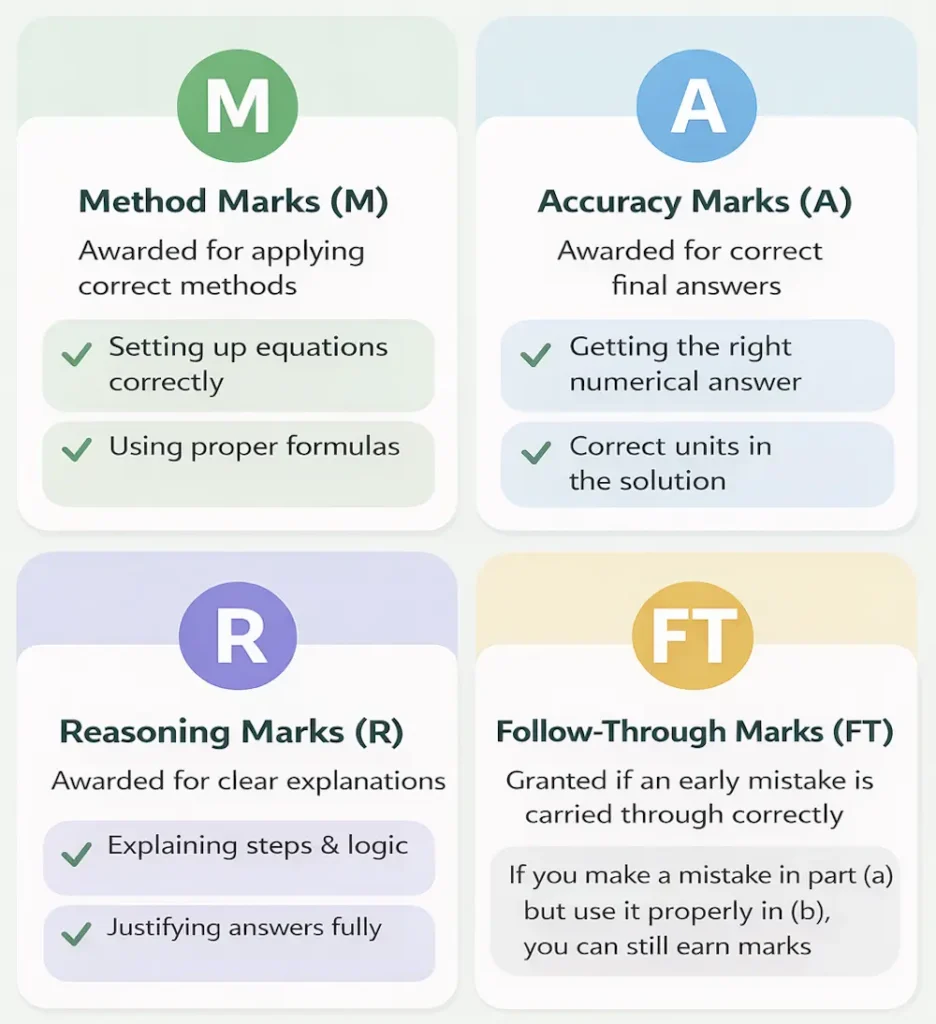
How IB Math Exams Are Marked (M, A, R Marks) ?
Understanding how IB Math exams are marked is key to maximizing marks at the exam. By knowing how marks are awarded, you can present your work more effectively and avoid losing easy marks.
Proven Ways to Maximize Marks
1. Always Show Full Working
Even if the answer seems obvious, write the steps clearly.
You can earn method marks even if the final answer is wrong.
2. Use Correct Mathematical Notation
Avoid calculator-style notation. Use proper IB format such as:
– dy/dx instead of “d/dx” shortcuts
– Exact values like ππ, not decimals
3. Understand Command Terms
Words like “show that”, “deduce”, and “justify” tell you exactly what to do.
→ Make sure you understand these fully to avoid losing easy marks.
4. Keep Answers in Exact Form
Do not round too early.
Example:
– Keep exact values such as 22, not 1.41
– Only round your answer at the final step, if required
– Use your calculator’s STO (store) function to maintain full precision
→ Maintaining accuracy throughout your working helps ensure you gain full marks, especially in multi-step questions
5. Use Your Calculator Properly
– Use full precision throughout your calculations
– Double-check your answers
– Make sure you input information correctly into the calculator
– Use parentheses to ensure the correct order of operations
→Small calculator mistakes can lead to lost marks, so accuracy and careful input are essential.
6. Continue Even If You know something is wrong
– Use your value in the next part
– Apply the correct method in subsequent steps
– Stay consistent with your working
→You can still gain marks through follow-through (FT) if your method is correct, even if an earlier answer was incorrect.
7. Manage Your Time Effectively
Good time management is essential to maximize your marks in IB Math exams.
– Don’t spend too long on one question
– Move on and return later
– Attempt every question
– As a general rule, spend roughly one minute per mark on each question
→Managing your time well ensures you can attempt the entire paper and avoid losing easy marks.
Section A vs Section B (IB Math AA)
Understanding the difference between Section A and Section B is key to approaching IB Math exams effectively and maximizing your marks in IB Math Exam.
Section A - Accuracy and Efficiency
Section A consists of shorter questions that test core skills and basic understanding.
To perform well in Section A:
– Focus on accuracy
– Show clear and concise working
– Avoid unnecessary steps
– Use your calculator efficiently (if allowed)
Most questions are worth fewer marks, so it’s important to work quickly, efficiently and avoid spending too much time on one question.
Section B - Method and Reasoning
Section B includes longer, structured questions, often with multi-part problems that require deeper understanding and clear communication.
To maximize marks in Section B:
– Show full working for every step
– Explain your reasoning where necessary
– Use correct mathematical notation
– Structure your answers clearly
Paper 1 vs Paper 2 (IB Math AA)
In IB Mathematics: Analysis and Approaches (AA), the exam is divided into two papers, each testing different skills and requiring a different approach.
Paper 1: No Calculator
Paper 1 tests your understanding of mathematical concepts without the use of a calculator.
Goal of Paper 1:
– Truly understand the underlying mathematics
– Can perform algebraic manipulation accurately
– Do not depend on technology for basic processes
This paper focuses on:
– Show clear and complete working
– Use correct algebraic methods
– Keep answers in exact form (e.g. √x, fractions)
– Avoid calculator-style shortcuts
👉 The goal is to assess your mathematical thinking, not your ability to use a calculator.
Paper 2: Calculator (Efficiency & Application)
Paper 2 allows the use of a calculator because it focuses on more complex calculations and problem-solving.
Goal of Paper 2:
– Allow students to handle more realistic and complex problems
– Save time on lengthy calculations
– Focus on interpretation and application rather than manual computation
This paper focuses on:
– Efficient problem-solving
– Use of technology
– Accuracy in numerical results
👉 The goal is to assess how well you can apply mathematics in more advanced situations, not just compute by hand.
Paper 1 vs Paper 2 (IB Math AI)
In IB Mathematics: Applications and Interpretation (AI), both Paper 1 and Paper 2 allow the use of a calculator. However, each paper tests different skills and requires a slightly different approach.
Paper 1: Shorter Questions and Core Skills
Focus on speed, accuracy, and efficient working
Paper 1 includes shorter, more direct questions testing core skills and the accurate application of methods.
– Applying methods correctly
– Accuracy in calculations
– Clear and concise working
To maximize marks:
– Work efficiently and manage your time carefully
– Show clear steps — do not rely only on the calculator
– Avoid rounding too early
– Use stored values to maintain accuracy
Paper 2: Longer Questions and Interpretation
Focus on method, structure, and interpretation
Paper 2 usually includes longer, structured questions, often set in real-life contexts
– Problem-solving
– Interpretation of results
– Communication and reasoning
To maximize marks:
– Show full working and clear structure
– Explain your reasoning where required
– Interpret results in context (including units)
– Use your calculator effectively
Identify the Topic and Choose the Right Method
Before starting a question, take a moment to identify the topic and the appropriate method needed to solve it.
Key tips:
– Recognize the topic (e.g. algebra, calculus, probability)
– Select the correct method or formula
– Avoid using unnecessary or incorrect techniques
– Plan your approach before solving
Choosing the right method early helps you work more efficiently and avoid mistakes
According to official IB guidelines, showing clear working is essential to gain method marks. Link to IB guidelines
Final Exam Tips
Before submitting your exam, take a moment to check your work carefully — small details can make a big difference.
Key reminders:
– Read each question carefully before starting
– Keep the goal of the question clear
– Make a plan of what you need to do before solving
– Show all your working clearly
– Avoid rounding too early
– Check calculations and final answers
– Include correct units where required
– Use proper mathematical notation
A few extra minutes of checking can help you recover valuable marks and avoid simple mistakes.
Need Help With IB Math?
If you are struggling with IB Math AA or AI, personalized tutoring can help you understand both the mathematics itself and the exam techniques needed to maximize marks. Check it out.
Lessons focus on:
mastering difficult topics
interpreting IB questions correctly
practicing with real exam-style problems
improving confidence and problem-solving skills
If you want structured guidance and exam preparation, you can book a free introductory lesson to see how online tutoring works.